Ectoparasiticides for external use
Ectoparasites: why it is important to use parasiticides in dogs and cats
PRODUCTS
External parasites are not only annoying and dangerous for our pets, but also for humans. For this reason, it is essential to take appropriate preventive measures based on the risk of infestation, using dog and cat parasiticides correctly.
Ectoparasites in dogs and cats.
External parasites or ectoparasites comprise several species of arthropods that belong taxonomically to the class Insects (fleas, lice, mosquitoes, flies and phlebotomus) and to the subclass Mites (ticks and mites).
Dogs and cats can be infested by one or more external parasites at the same time, once or several times in their lives, sometimes periodically.
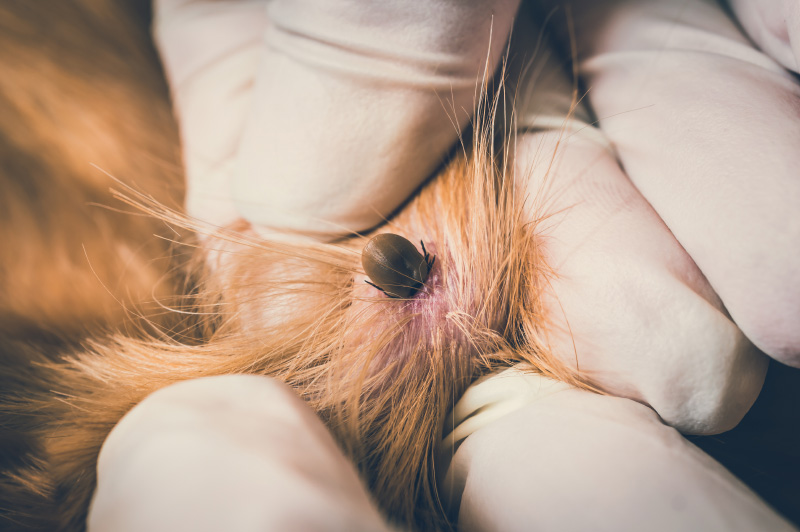
External parasites are a real problem for animals because they can:
- cause skin lesions
- induce an immunopathological reaction
- carry disease-causing pathogens
- be agents of zoonoses (infections or diseases that can be transmitted directly or indirectly between animals and humans) or contribute to their transmission.
Fleas
For more information see the page on flea infestation in dogs and cats.
Lice
Lice are divided into chewing and sucking lice according to the way they feed on the host.
Chewing lice feed on skin debris and waste, while sucking lice have a buccal apparatus that allows them to prick the host and feed on its blood.
Phlebotomus
Phlebotomus or sandflies are very similar to a small mosquito.
Mosquitoes
Apart from their annoying bites, these parasites pose a severe problem as they are vectors of many pathogens including Dirofilaria immitis, the causative agent of filariasis.
Ticks
Ticks are ‘temporary’ hematophagous parasites, i.e. they spend only part of their life cycle on the host. They alternate periods of parasitic life on the host with periods of life in the environment, where they moult from one stage to the next and lay their eggs.
In addition to their hematophagy action, ticks are very dangerous as they can be vectors of pathogens (viruses, bacteria, protozoa, etc.), often of zoonotic significance.
Mites
Mites are parasites of dogs and cats that, depending on the species, live on the animal’s skin or inside the ear canals. They are almost completely invisible but very annoying. In most cases they cause intense itching and animals, by scratching themselves, can cause skin lesions from self-trauma.
More information on external parasites and their control can be found in the ESCCAP guidelines (European Scientific Counsel Companion Animal Parasites).
When to use cat and dog parasiticides for external use
In general, it is advisable to carry out a parasite prevention treatment during all periods of the year. However, prevention measures should be taken even more scrupulously in the spring-summer season since parasites tend to reproduce and spread faster on animals and in the environment in favourable climatic conditions.
In addition, the risk of infestation varies from subject to subject depending on the environment (outdoor or indoor) and climatic conditions in which the animal lives, its age and state of health, so any preventive treatment must be defined specifically on the basis of risk.

Types of parasiticides for external use
Parasiticides for dogs and cats fall into two categories: those for external use and those for oral use. Parasiticides for external use may differ in formulation, mode and frequency of application:
- spot-on solutions (so-called ‘pipettes’ for dogs and cats)
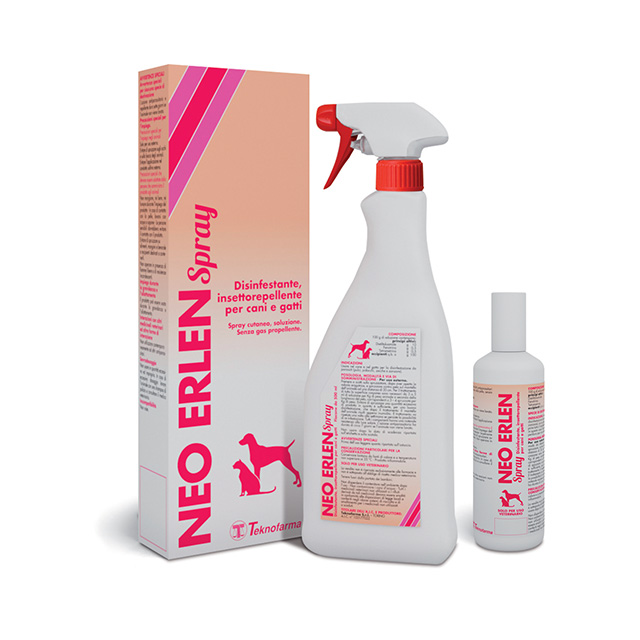
- sprays
- parasiticide shampoos
- antiparasitic collar.
The active ingredients used in these products fall roughly into two categories: those with mainly parasiticidal activity and those with mainly insect-repellent activity.
Active ingredients with ectoparasiticidal activity
An antiparasitic active ingredient of plant origin (made from the flowers of the plant Chrysanthemum cinerariifolium), widely used especially topically, is Pyrethrum extract, often associated with other active ingredients with synergistic effect that prolong and enhance its ectoparasiticidal action (such as Piperonyl Butoxide). The transcutaneous absorption of Pyrethrum extract is 2%, so toxicity is very low, and side effects are uncommon.
Synthetic pyrethroids are active ingredients with ectoparasiticidal activity that are commonly used. These include Permethrin and Deltamethrin, which have ectoparasiticidal and insect-repellent activity. However, because of the particular sensitivity of cats to these molecules, due to a deficiency in the enzyme glucuronyltransferase, some products containing them cannot be used on cats as they are toxic.
Another widely used synthetic pyrethroid is Flumethrin.
The group of synthetic pyrethroids also includes Tetramethrin and Phenothrin, both characterised by a wide safety margin in dogs and cats. Tetramethrin is characterised by a predominantly knock-down action, i.e. it causes the immediate immobilisation of the parasite by contact, while Phenothrin has a predominantly insecticidal action. Usually, Tetramethrin and Phenothrin are combined with each other and/or with other active ingredients with synergistic effect that prolong their duration of action (such as Piperonyl Butoxide).
Another commonly used ectoparasiticide molecule is Fipronil, which eliminates fleas within 24 hours and ticks and lice within 48 hours of its application. Given its high efficacy by contact (fleas do not need to bite the host to be killed), it is particularly suitable for those individuals who show signs of flea bite allergy (FAD). Fipronil is often combined with Metoprene and Pyriproxifen, two insect growth regulators that interrupt the flea life cycle by causing the production of infertile eggs and blocking the development of fleas from juveniles to adults.
Other known active ingredients with ectoparasiticidal action against one or more types of external parasites in dogs and/or cats are Amitraz,Diazinone, Dinotefuran, Imidacloprid, Indoxacarb, Pyriprole, Propoxur, Selamectin, Trichlorfon.
Active ingredients with insect-repellent activity
The molecule with the highest insect-repellent activity is Diethyltoluamide (DEET. It is also used in humans in numerous non-specific prophylaxis protocols for diseases transmitted by bloodsucking insects, partly on account of its high safety of use. DEET, when sprayed on animals, is in fact able to create a sort of protective barrier against the main external parasites.
Some of the active ingredients with ectoparasiticidal activity mentioned above, e.g. synthetic pyrethroids (Phenothrin, Tetramethrin, Permethrin, etc.), also have mild insect-repellent properties. However, these are insufficient to provide adequate protection to the animal, which is why these active ingredients are often combined with DEET.


Oral parasiticides
For some years, oral parasiticides active against fleas and ticks have also been available on the market as tablets or chewable tablets.
Among the most widely used active ingredients in these products are isoxazolines (Afoxolaner, Fluralaner, Lotilaner, Sarolaner), recently introduced (since around 2014), which are active against fleas and ticks.
In many products, isoxazolines are combined with other active ingredients (generally belonging to the category of macrocyclic lactones) to extend the spectrum of action to other external and internal parasites in addition to fleas and ticks.
A less recent active ingredient is nitenpyram, from the chemical class of neonicotinoids, used. for oral use to eradicate fleas in dogs and cats.
In summary, since external parasites are not only a source of annoyance and discomfort for animals but can also be vectors of diseases that can also affect humans, it is necessary to take appropriate prophylactic measures using specific antiparasitic products for dogs and cats.
The choice of a particular type of parasiticides should always be made taking into account primarily the risk of infestation of a particular animal, which depends on numerous factors including species, age, health conditions and living environment.