
NSAIDs and analgesics
Anti-inflammatories for dogs and cats: what they are and why they are used
Animals are not able to express their pain in words, but they feel it and suffer all the consequences, just as humans do. Uncontrolled pain has unfavourable effects, as it can easily become chronic, with a clear impact on the animal’s quality of life. Knowing how to recognise and properly treat pain is therefore an essential component of veterinary care. Several categories of drugs can be used for pain control, including anti-inflammatory drugs for dogs and cats.
What is pain?
The IASP (International Association for the Study of Pain) defines pain as an unpleasant sensory and emotional experience associated with actual or potential tissue damage.
The pain experience consists of three phases:
-
nociception, i.e. the activation of specific receptors (nociceptors) by noxious stimuli and their transmission along nerve fibres;
-
the processing and interpretation of these stimuli by the cerebral cortex, resulting in the conscious perception of pain and the subsequent emotional responses;
-
behavioural changes in response to pain.
Types of pain
Both humans and animals experience different types of pain with different consequences on the organism.
Physiological pain is defined as a type of pain – generally quick to appear and of a transitory nature – which serves as protective alarm signal to prevent or minimise tissue damage: through the perception of the painful sensation, the animal adopts certain behavioural responses aimed at preventing the propagation of the pathological process. Physiological pain is usually associated with mild or no tissue trauma.

Pathological pain, instead, is defined as pain linked to significant tissue damage and the ensuing inflammatory process (acute pain). Like physiological pain, it too initially has a protective purpose: it limits the extent of damage, encourages immobility, facilitates wound healing, etc. With these characteristics, acute pain is defined as adaptive.
If pain is not adequately treated, physiological changes occur that lead to its evolution into maladaptive pain, which is more serious and difficult to control as it evolves into chronic pain, which no longer has a spatial-temporal correlation with the triggering insult.
In these cases, alterations in nerve activity can occur at both the central and peripheral levels, which together lead to hyperalgesia (increased response to painful stimuli) and allodynia (reduced pain threshold).
Maladaptive pain is debilitating and drastically reduces the animal’s quality of life, leading over time to the onset of pathophysiological alterations that can in turn interfere with the healing of the initial injury. This prolongs the painful stimulus, thus establishing a vicious circle with devastating consequences for the organism.
Inflammatory pain: why are anti-inflammatory drugs used in dogs and cats?
In animals as well as in humans, inflammation represents the response of any tissue to damage of various kinds; it has a protective role as it is aimed at removing the causative agent, thus restoring the normal structure and function of the tissue involved.
However, under certain conditions, if the damage is particularly severe and extensive or if the underlying cause persists, the inflammatory process becomes chronic.
In such cases it is necessary to resort to the use of anti-inflammatory drugs for dogs and cats.
These reduce the ongoing inflammatory response as they interfere with the synthesis and release of the main inflammatory mediators.
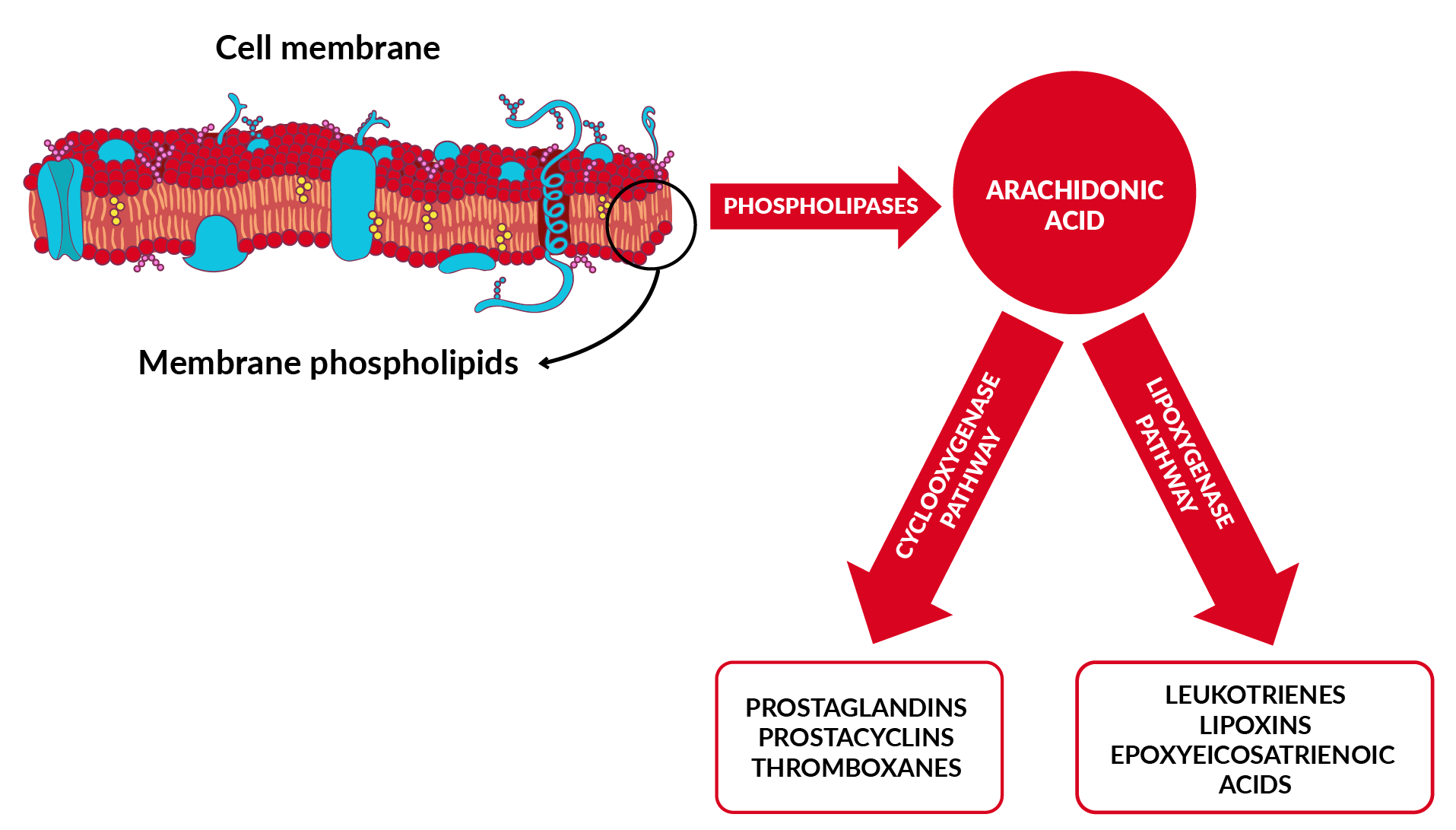
Arachidonic acid, contained in membrane phospholipids, is the main precursor of these mediators. In case of damage to cell membranes, specificenzymes called phospholipases are activated and release arachidonic acid from the cell membrane. Arachidonic acid is then used for the synthesis of inflammation mediators via two enzymatic pathways: lipoxygenase (LOX) and cyclooxygenase (COX).
Cyclooxygenases exist in two isoforms:
Non-selective NSAIDs
Non-selective NSAIDs inhibit both forms of COX. Their use not only reduces the biosynthesis of inflammation mediators, but also of those that regulate other biological processes (gastric protection, renal protection, haemostasis). As such, they may cause gastrointestinal (nausea, vomiting, diarrhoea, abdominal pain, erosions and ulcers), renal (renal ischaemia and acute renal failure) and haemostatic (coagulation disorders) side effects. Veterinary anti-inflammatory drugs for dogs and cats in this category include tolfenamic acid.
Selective COX-2 inhibitor NSAIDs
Selective COX-2 inhibitor NSAIDs modulate the production of substances with pro-inflammatory action while interfering only minimally with the synthesis of protective mediators. For these reasons, we can generally say that these NSAIDs provide good therapeutic efficacy with a lower incidence of undesirable side effects than non-selective NSAIDs. Veterinary anti-inflammatory drugs that are selective COX-2 inhibitors include meloxicam, carprofen, firocoxib and robenacoxib.
-
COX-1 which determines the formation of mediators that ensure the protection of the gastroenteric mucosa, proper haemostasis (the set of processes that regulate coagulation) and good blood flow in the kidneys;
-
COX-2 which causes the production of high amounts of the mediators responsible for the appearance of the typical clinical signs of an inflammatory process, i.e. heat of the inflamed part, redness, swelling, pain and functional impairment.

Types of anti-inflammatory drugs for dogs and cats
Non-steroidal anti-inflammatory drugs (NSAIDs) are widely used in Veterinary Medicine thanks to their anti-inflammatory, analgesic and antipyretic action. The term ‘non-steroidal’ distinguishes these drugs from steroids (cortisone and derivatives), which, while having a similar anti-inflammatory action, have a wide range of other effects. NSAIDs are divided into two classes according to their selectivity toward cyclooxygenase enzymes:
-
non-selective NSAIDs
-
selective COX-2 inhibitor NSAIDs.
Meloxicam
Meloxicam has a very high margin of safety and, when administered at therapeutic dosages, adverse effects are rarely observed.
Meloxicam is one of the most widely used drugs to treat arthritis in dogs; numerous studies in the literature demonstrate that administering this active ingredient can significantly improve the clinical symptoms of arthritis patients. It is also widely used, for short periods, to control post-operative pain and inflammation.
Meloxicam is available in various formats: tablets, oral solutions, and injectable solutions for dogs, cats and exotic animals.
In summary, animals too perceive pain at a conscious level. In addition to identifying the triggering causes, it is essential to recognize the type of pain and treat it appropriately in order to prevent it from becoming chronic and leading to the onset of other pathological alterations that would inevitably impair the animal’s quality of life.